
Pamukkale.ioHierapolis & beyondExplore
Hierapolis Plutonium: The Gate to Hell Explained
The Plutonium at Hierapolis really did kill visitors in antiquity. Here's the CO2 science behind it, and what's left to see today.
Updated
Hierapolis Plutonium: The Gate to Hell Explained
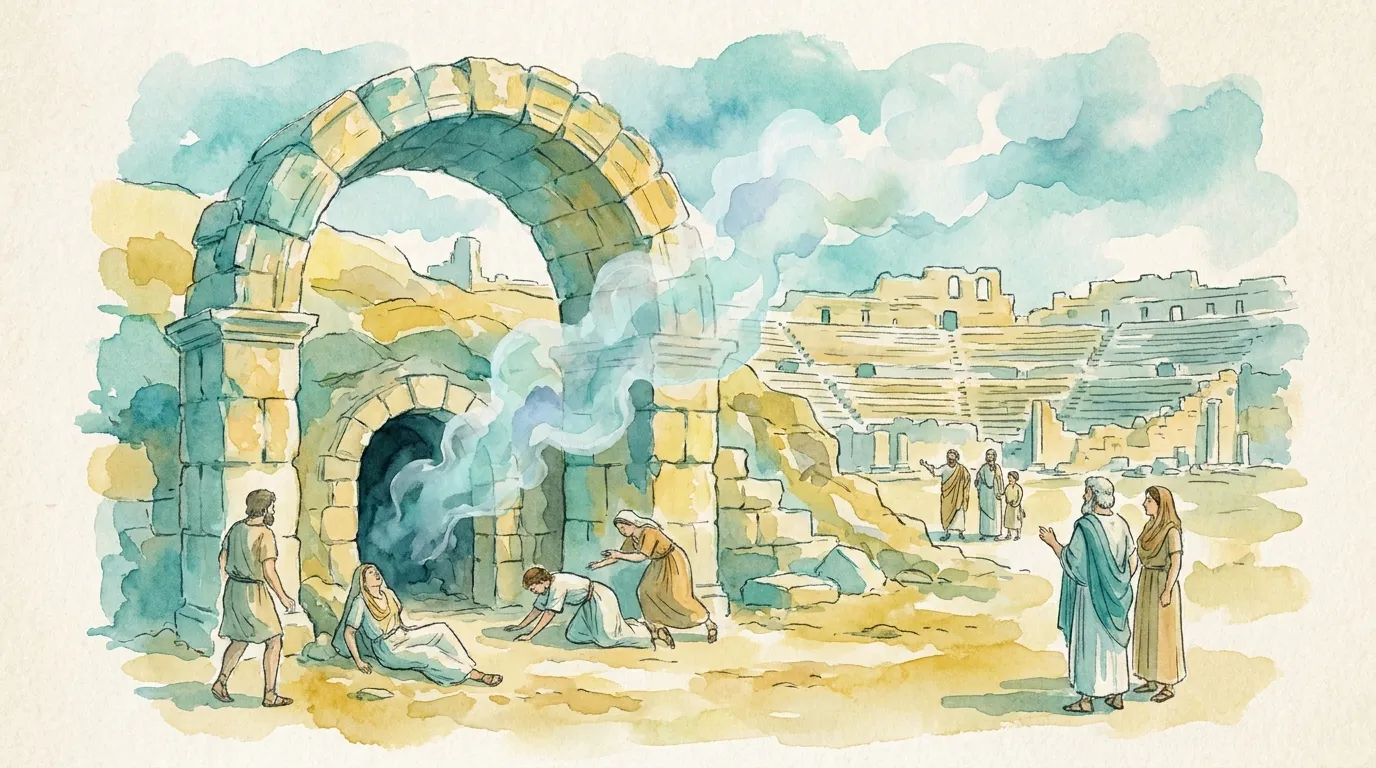
The Plutonium at Hierapolis is a small cave sanctuary dedicated to Pluto, god of the underworld, and it earned its reputation honestly: animals that walked into it died within minutes, while the priests who tended it walked away unharmed. The mystery wasn’t magic. It was carbon dioxide, and the site is dangerous enough that the cave itself is still closed to visitors today. What remains open is the platform around it, a rebuilt Hades and Cerberus, and one of the more striking small monuments in Hierapolis.
A gate to the underworld, according to Rome
Ancient sources treated the Plutonium as a literal doorway to Hades. Strabo described it as a hole beneath a fenced enclosure, releasing a vapor so dense that any animal that entered dropped almost instantly. Roman visitors came specifically to test this: bulls, sparrows, even dogs were sent in as demonstrations, and none came back out alive. The eunuch priests of Cybele, known as the Galli, went in freely and returned fine, which convinced pilgrims that they carried some kind of divine protection.
The site sits directly against the Temple of Apollo, and that pairing wasn’t accidental. In the Greco-Roman world, sanctuaries built over natural gas vents were treated as oracular ground, places where the earth itself spoke. Hierapolis had both a temple to the god of light and prophecy and, a few meters away, a passage to the god of the dead. The two structures share a foundation wall, and if you stand at the theatre above and look down, you can see how tightly they’re packed into the same terrace.
Why the cave actually killed animals
The science behind the myth is straightforward once you know what’s underneath. Hierapolis sits on active geothermal ground, the same system that feeds the thermal water at the antique pool nearby. That geology also vents carbon dioxide, and inside the confined space of the Plutonium cave, the gas has nowhere to disperse. CO2 is heavier than air, so it settles low and thick near the cave floor. A bull or a sparrow, with its head down near ground level, breathed pure CO2 and lost consciousness within seconds. A priest standing upright, head well above the gas layer, was breathing normal air the entire time. No miracle, just a matter of height.
A 2018 study by geologist Hardy Pfanz measured CO2 concentrations at the cave mouth reaching close to 90% overnight, when cooler temperatures let the gas pool undisturbed. During the day, sunlight and wind break up the layer somewhat, but readings near the entrance still spike well above safe levels. That’s the reason the cave stays fenced off even now: the same gas that killed sacrificial bulls two thousand years ago hasn’t gone anywhere.
What’s left to see after the 2013 discovery
For decades the Plutonium’s exact location was uncertain, buried under collapsed masonry and centuries of sediment. Italian archaeologist Francesco D’Andria and his team relocated and excavated it in 2013, uncovering the cave entrance, a set of theatre-like stone steps used as viewing seats in antiquity, and enough of the original structure to confirm the ancient descriptions were accurate almost to the letter.
Today’s visit is a viewing experience, not an entry. A glass barrier and a walkway keep you a safe distance from the cave mouth, where you can usually see a faint haze rising from the warm, mineral-heavy water below. Restored statues of Hades and his three-headed dog Cerberus stand near the site, giving some shape to what was otherwise just a hole in the ground. Recent excavation seasons in the wider Hierapolis area have continued to turn up inscriptions and structural details around the sanctuary, so the exact layout open to the public shifts a little year to year.
Finding it isn’t obvious on a first visit. The Plutonium sits directly below the Hierapolis theatre, tucked against the Apollo temple ruins rather than out on its own. If you’re heading there, budget it as a stop within a longer walk through the ancient city rather than a separate destination, and check the current ticket and hours page before you go, since access points inside Hierapolis get adjusted as excavation work continues.
The Plutonium won’t take long to see, five or ten minutes at the platform is enough, but it’s worth timing it against the rest of your Hierapolis walk. For the fuller layout of temples, baths, and the necropolis around it, the Hierapolis ancient city guide lays out a route that puts this stop where it makes sense.
Where these places are
Distances from the travertine entrance. Tap a marker to open its guide.
All places on this map
- The Antique Pool (Cleopatra's Pool)
- The travertine terraces of Pamukkale
- Hierapolis Ancient City (Guide coming soon) · 0.7 km from the terraces
- Karahayıt: the red thermal springs · 5.1 km from the terraces
- Laodikeia: the ruined city across the valley · 9.9 km from the terraces
- Denizli: the working city next to Pamukkale · 15.9 km from the terraces
- Tripolis: a Roman city on the Meander with almost no one in it (Guide coming soon) · 19.8 km from the terraces
- Kaklık Cave: Pamukkale underground · 24.2 km from the terraces
- The Çal vineyard route: high-altitude wine an hour from Pamukkale (Guide coming soon) · 29.6 km from the terraces
Guided tours and day trips in Pamukkale
Skip the planning. Pick a theme below to compare guided tours, balloon rides and day-trip packages, many with instant confirmation and free cancellation.
- Pamukkale + Hierapolis day tour
- Hot air balloon ride
- Sunset tour
- Day trip from İzmir
- Day trip from Antalya
- Cleopatra antique pool
Coming out this way?How to get there →