
The Roman Theatre of Hierapolis
The single best-preserved monument above Pamukkale: a Roman theatre carved into the hillside, its ornate stage building still standing with reliefs of gods and emperors. What to see, when the light is best, and how to walk it.
Updated
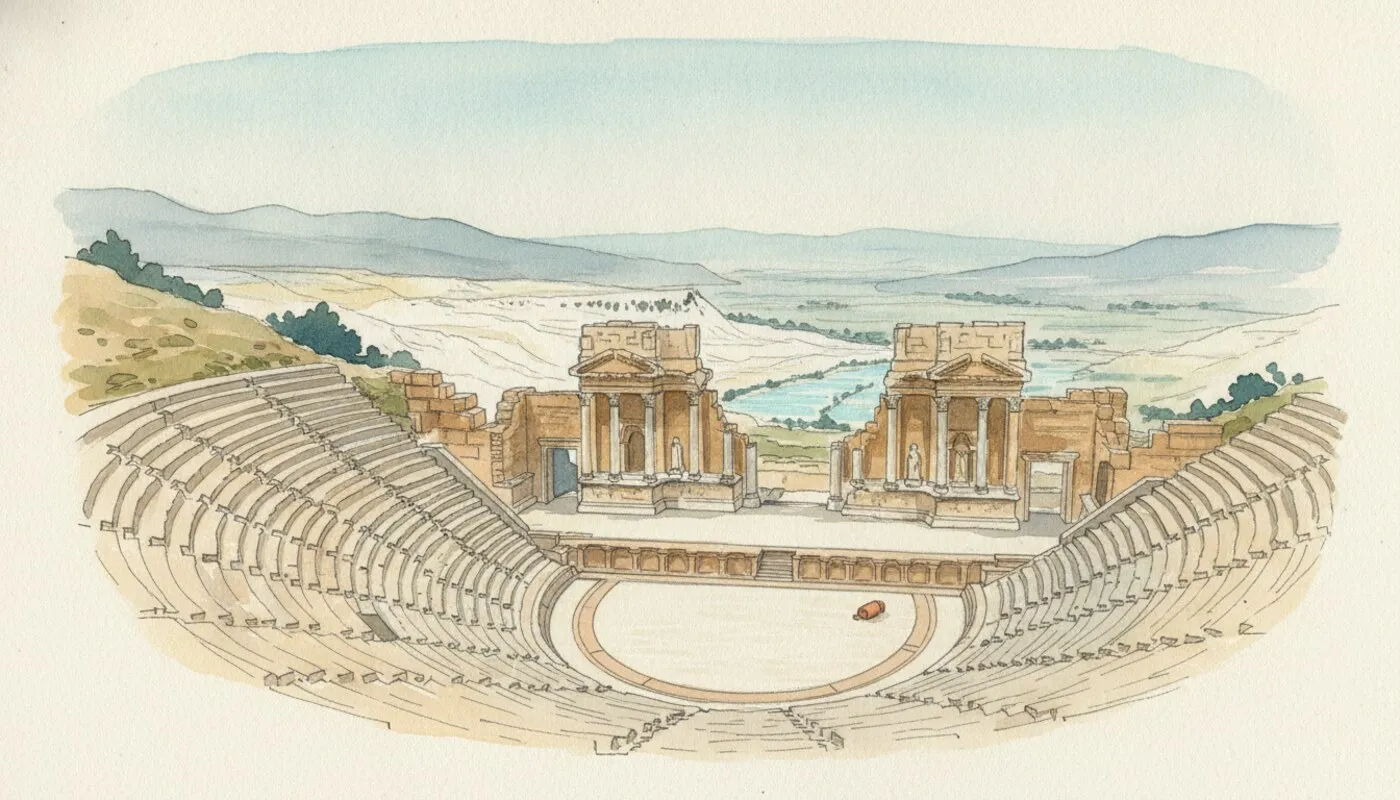
Climb through Hierapolis, past the colonnaded street and the tumbled stones, and the ground suddenly rises into a great curved bowl set into the hillside. This is the Roman theatre, and it is the moment most people remember from the city above Pamukkale. Where much of Hierapolis is foundations and fragments, here a whole monument survives, seats, stairways and an ornate stage front still holding their shape after nearly two thousand years.
Why the theatre is the highlight
Most of the ancient city asks you to imagine what once stood. The theatre does the opposite: it hands you the real thing. It is counted among the best-preserved Roman theatres in Anatolia, its seating bowl carved straight into the slope so the hill itself carries the weight of the crowd. On the Hierapolis city guide you will find the full sweep of the site, from the necropolis to the Gate of Pluto; this page stays with the one building that repays a slower look.
The stage building and its reliefs
What sets this theatre apart is the skene, the tall stage building facing the seats. Elsewhere these have usually collapsed; here a large part still stands, rebuilt and decorated in the imperial age. Look closely at the stone front and you can pick out carved friezes, processions of gods and mythological scenes, with Apollo, the city’s patron, and Artemis and Dionysus among the figures. Some of the finest panels are now sheltered in the site museum, but enough remains in place to show how richly the stage was dressed.
Climb the seats for the view
Do not stop at the bottom row. Climb, and with every step the valley widens beneath you until the whole plateau and the white terraces open out below. The upper rows catch a breeze even at the hottest hour, and the acoustics still carry a quiet voice from the stage. Sit for a moment where an audience of thousands once sat for the same view, and the scale of Hierapolis stops being a fact and becomes something you feel.
When to come, and what to bring
The theatre faces open sky with almost no shade, so timing matters more than anything. Early morning and the last hours before closing are cooler, quieter and far kinder to photographs, when low light rakes across the carved stage. Bring water, a hat and shoes you can climb steps in. For the season and hour that suit the whole site, see the best time to visit Pamukkale page.
Practical: ticket, time, getting up here
Entry to the theatre is part of the standard site ticket, the same one that opens the terraces and the rest of Hierapolis; for current prices and hours see the tickets and opening hours page. Reaching it is simply a matter of walking up through the city from either gate. Thirty minutes covers a good visit, an hour if you linger.
When you come back down, the warm Antique Pool is a short walk away, and the white terraces drop off just below the city. The theatre is the reason to climb; the rest of the site is the reward for having done it.
Where these places are
Distances from the travertine entrance. Tap a marker to open its guide.
All places on this map
- The Antique Pool (Cleopatra's Pool)
- The travertine terraces of Pamukkale
- Hierapolis Ancient City · 0.7 km from the terraces
- Karahayıt: the red thermal springs · 5.1 km from the terraces
- Laodikeia: the ruined city across the valley · 9.9 km from the terraces
- Denizli: the working city next to Pamukkale · 15.9 km from the terraces
- Tripolis: a Roman city on the Meander with almost no one in it (Guide coming soon) · 19.8 km from the terraces
- Kaklık Cave: Pamukkale underground · 24.2 km from the terraces
- The Çal vineyard route: high-altitude wine an hour from Pamukkale (Guide coming soon) · 29.6 km from the terraces
Guided tours and day trips in Pamukkale
Skip the planning. Pick a theme below to compare guided tours, balloon rides and day-trip packages, many with instant confirmation and free cancellation.
- Pamukkale + Hierapolis day tour
- Hot air balloon ride
- Sunset tour
- Day trip from İzmir
- Day trip from Antalya
- Cleopatra antique pool
Coming out this way?How to get there
Common questions
Is the Hierapolis theatre included in the Pamukkale ticket?
Yes. The theatre sits inside the archaeological site, so your single Hierapolis and Pamukkale entry covers it with no extra charge. Only the Antique Pool has its own separate ticket. Once you have walked up the white terraces, the theatre is a short climb further into the city.
How big is the theatre and how old is it?
It is one of the best-preserved Roman theatres in Anatolia, cut into the slope with a seating bowl that held on the order of twelve to fifteen thousand people. Most of what you see took shape in the 2nd and early 3rd centuries AD, with an ornate stage building added and restored under the emperors of that age.
How long do you need at the theatre?
Half an hour is enough to climb the seats, take in the view over the valley and look at the carved stage front. Give it an hour if you want to sit for a while or wait for softer light. There is little shade, so early morning or late afternoon is far more comfortable than midday.