
Laodikeia: the ruined city across the valley
Ten minutes from Pamukkale, one of Turkey's largest active excavations spreads across the opposite ridge: a monumental Roman street, two theatres, and one of Revelation's seven churches, with hardly anyone around.
Updated
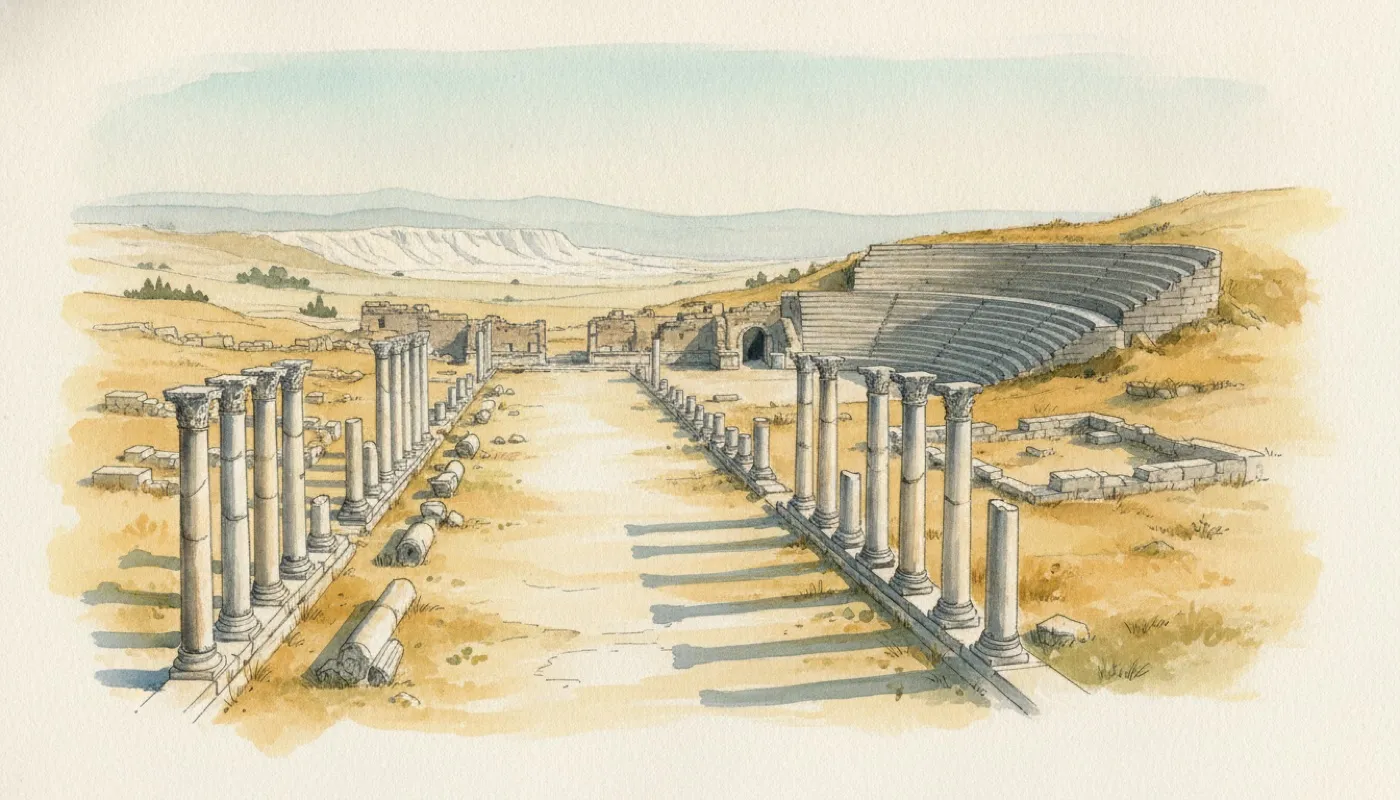
Stand on the Pamukkale terraces and look across the valley: the low ridge on the far side is not empty. That is Laodikeia, a Roman city that once rivalled anything in the region, now spread out over the hillside as one of Turkey’s biggest live excavations. It is barely ten minutes from the white cliffs, yet most people never cross the valley to see it, which is exactly why it is worth doing.
What you actually walk through
Laodikeia is not a single monument, it is a whole city you move through on foot. The spine is a long, monumental colonnaded street (the Syria Street), once lined with shops and running arrow-straight through the centre. Off it you find:
- Two theatres cut into the slope, still holding their curved rows of seats.
- A broad agora and the footings of temples and public buildings.
- One of the earliest Christian churches ever excavated, with its layout and font still readable on the ground.
Because the dig is still active, the place changes year to year, new streets and buildings keep emerging from the earth, so it feels less like a finished museum and more like a city being gently woken up.
One of the seven churches, and the lukewarm water
Laodikeia carries a story that ties it straight back to Pamukkale’s heat. It was one of the seven churches named in the Book of Revelation, and its famous line, that the city was “neither cold nor hot” but lukewarm, is usually read as a dig at its water supply. Cold springs and the region’s hot thermal water both had to travel to the city by aqueduct, and by the time either arrived it was tepid. You can still see stretches of that stone water system on site. It is a small, human detail that quietly links Laodikeia to the same thermal world that feeds Pamukkale’s travertines and the red springs at Karahayıt.
Visiting it: shade, crowds and time
The honest practical picture:
- It is wide and open, with very little shade. In summer bring a hat and water, and don’t come at midday if you can help it.
- It is quiet. Compared to the terraces you will often have whole streets to yourself, which is a large part of the charm.
- Give it an hour to ninety minutes on foot. The distances between the main points are real, so wear proper shoes.
Fitting it into a Pamukkale trip
Laodikeia slots neatly onto the same day as the terraces. See Pamukkale in the soft early light, then drive over to Laodikeia when the crowds build at the pools, or reverse it and finish at the terraces for sunset. Either way you are pairing the geology of Pamukkale with the history right across the valley, which is the whole point of taking your time in the wider Denizli region rather than treating it as a single photo stop.
Where these places are
Distances from the travertine entrance. Tap a marker to open its guide.
All places on this map
- The Antique Pool (Cleopatra's Pool)
- The travertine terraces of Pamukkale
- Hierapolis Ancient City · 0.7 km from the terraces
- Karahayıt: the red thermal springs · 5.1 km from the terraces
- Laodikeia: the ruined city across the valley · 9.9 km from the terraces
- Denizli: the working city next to Pamukkale · 15.9 km from the terraces
- Tripolis: a Roman city on the Meander with almost no one in it (Guide coming soon) · 19.8 km from the terraces
- Kaklık Cave: Pamukkale underground · 24.2 km from the terraces
- The Çal vineyard route: high-altitude wine an hour from Pamukkale (Guide coming soon) · 29.6 km from the terraces
Guided tours and day trips in Pamukkale
Skip the planning. Pick a theme below to compare guided tours, balloon rides and day-trip packages, many with instant confirmation and free cancellation.
- Pamukkale + Hierapolis day tour
- Hot air balloon ride
- Sunset tour
- Day trip from İzmir
- Day trip from Antalya
- Cleopatra antique pool
Coming out this way?How to get there
Common questions
What is Laodikeia?
Laodikeia was a wealthy Roman city in the Lykos (Çürüksu) valley, just north of modern Denizli. Today it is one of Turkey's largest active archaeological digs, with a monumental colonnaded street, two theatres, temples, an agora and one of the earliest churches ever excavated. It sits on the ridge facing Pamukkale, in clear view of the white terraces.
Is Laodikeia worth visiting alongside Pamukkale?
Yes. It is only about ten minutes away by car, and it gives you the human, historical side of the same landscape. Where Pamukkale is geology, Laodikeia is a whole Roman city you can walk through, usually with very few other people around.
How long do you need at Laodikeia?
About an hour to an hour and a half is enough to walk the main street, both theatres and the church without rushing. The site is large and open, so give yourself time, water and shade in summer.