
The travertine terraces of Pamukkale
What the white terraces actually are, how to walk them barefoot without slipping, and how to catch them at their best: full of water and lit soft, not washed out by the midday sun.
Updated
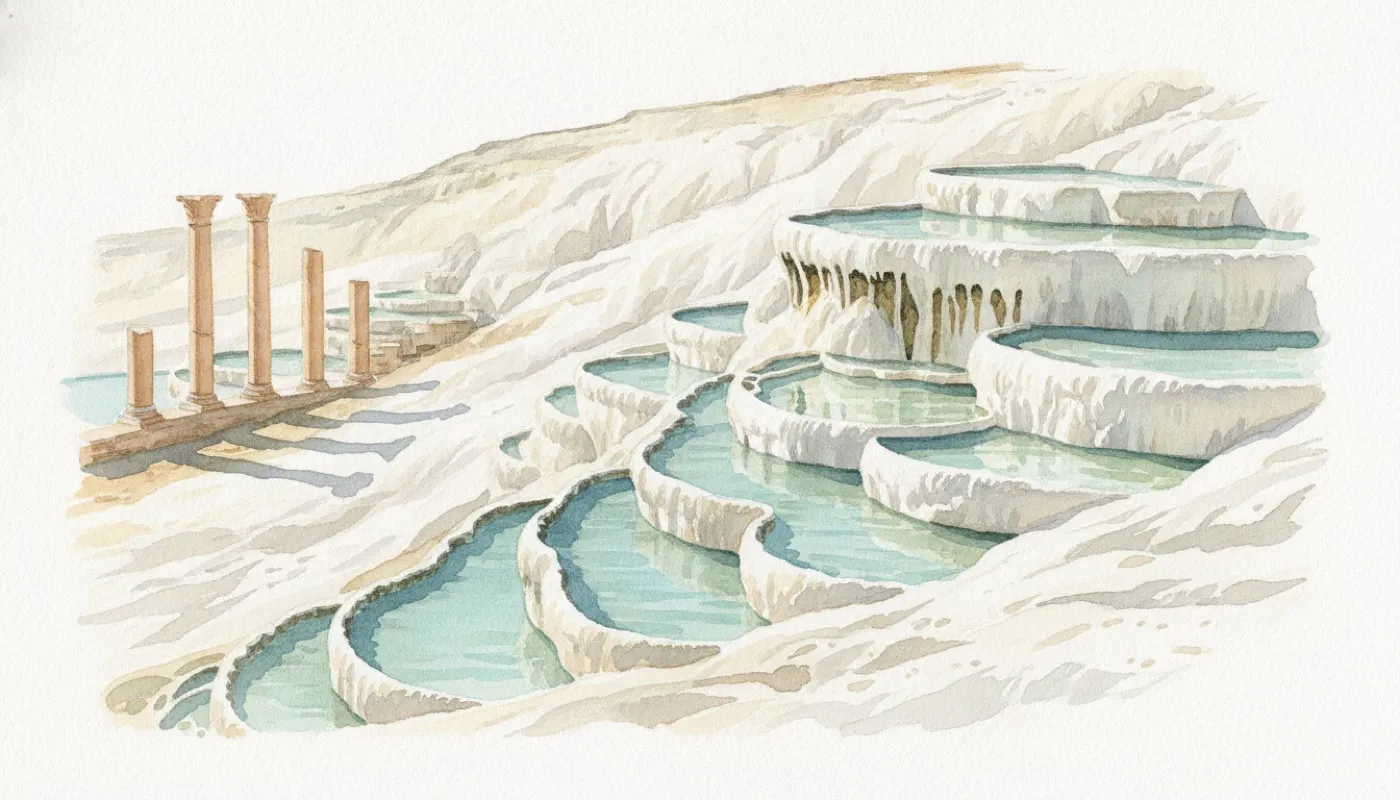
Up close, the famous white is not snow and not marble. It is travertine, a soft rock left behind by the thermal springs that rise through the hill. The water comes up warm and loaded with calcium; as it cools and spreads down the slope it drops that calcium as a chalky crust, building the rims, basins and frozen-waterfall shapes one thin layer at a time. What you are walking on is the spring writing itself onto the hillside.
Walking the terraces
You climb the white slope barefoot. Shoes would scratch and stain the travertine, so everyone carries them and wades the marked path in a few centimetres of warm water. It feels strange for the first minute and completely natural after that.
- Where the water runs, the surface is ridged and surprisingly grippy.
- Where it is dry, the white can be slick and hard, so slow down and watch your footing.
- Give yourself time. This is a walk to linger on, not to power through.
Full pools, empty pools
One thing worth knowing before you go: not every basin is full. The site rotates the flow to protect the formation, so on any given day some pools are brimming and blue while whole sections sit dry and bone-white. Both are beautiful, but if your heart is set on the mirror-pool photo, aim for the lower terraces where water tends to collect, and be ready to move along the path to find the full ones.
The right light
The terraces face the afternoon sun and the white throws it right back, so midday is the harsh, crowded low point. Come in the first hour after opening for cool, quiet, empty-pool photographs, or in the last hours before closing, when the day-trip coaches leave and the low sun turns the whole slope gold. For the full breakdown of season and hour, see when to visit.
Right above you: Hierapolis
The terraces do not end at the top of the slope. They spill straight into Hierapolis, the Roman spa city, its theatre, its long colonnaded street and the swimmable Antique Pool. Most tickets cover both, so plan to keep walking upward rather than turning back at the rim.
Where these places are
Distances from the travertine entrance. Tap a marker to open its guide.
All places on this map
- The Antique Pool (Cleopatra's Pool)
- The travertine terraces of Pamukkale
- Hierapolis Ancient City · 0.7 km from the terraces
- Karahayıt: the red thermal springs · 5.1 km from the terraces
- Laodikeia: the ruined city across the valley · 9.9 km from the terraces
- Denizli: the working city next to Pamukkale · 15.9 km from the terraces
- Tripolis: a Roman city on the Meander with almost no one in it (Guide coming soon) · 19.8 km from the terraces
- Kaklık Cave: Pamukkale underground · 24.2 km from the terraces
- The Çal vineyard route: high-altitude wine an hour from Pamukkale (Guide coming soon) · 29.6 km from the terraces
Entry tickets for Hierapolis-Pamukkale
Book your entrance ahead and walk in with a mobile ticket. No queue at the gate, and easy to reschedule if your plans change.
Guided tours and day trips in Pamukkale
Skip the planning. Pick a theme below to compare guided tours, balloon rides and day-trip packages, many with instant confirmation and free cancellation.
- Pamukkale + Hierapolis day tour
- Hot air balloon ride
- Sunset tour
- Day trip from İzmir
- Day trip from Antalya
- Cleopatra antique pool
Common questions
Can you walk on the Pamukkale terraces?
Yes, on a marked barefoot path. Shoes are not allowed on the white travertine to protect it, so you carry them and walk in the warm shallow water. The surface is ridged and grippy in the wet areas and slick where it is dry, so take it slowly.
Are the pools always full of water?
No. The flow is managed and rotated between sections, so some basins are brimming and mirror-blue while others are dry white. There is always water somewhere on the path, but do not expect every pool in the photos to be full on the day you visit.
Do you need to bring anything?
Something to carry your shoes, water to drink, and sun protection, the white surface reflects the sun straight back at you. A small towel helps if you want to sit and dip your feet.