
Two days in Pamukkale: travertines, Hierapolis and Laodikeia
The two-day route we walk with our own guests: terraces at first light, Hierapolis above them, Laodikeia across the valley, a thermal soak in between.
Updated · 5 min read
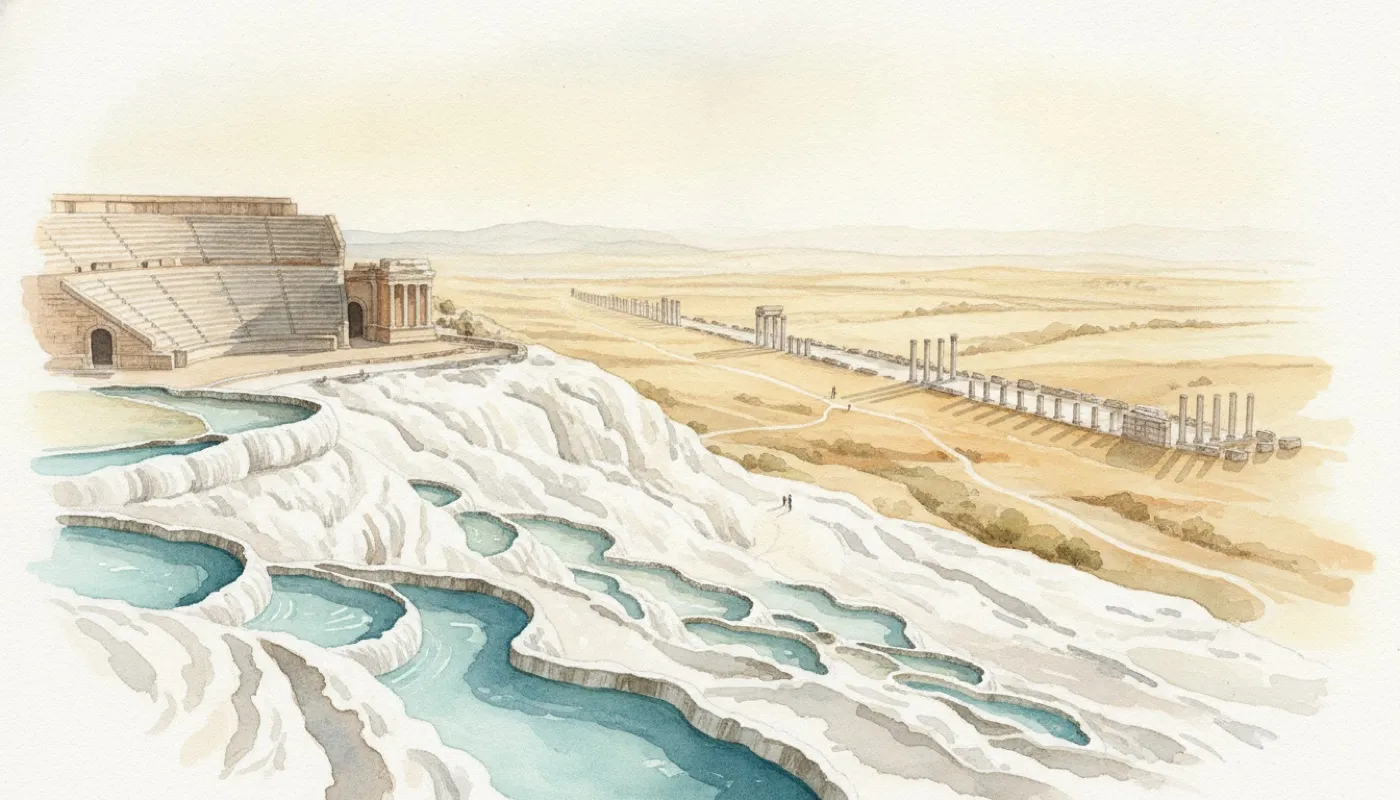
Most visitors give Pamukkale three hours. They step off a midday bus, walk the terraces in the harshest light of the day, take the photo and leave. Every time we watch it happen, the same thought crosses our minds: someone should tell them what one night here changes.
We live here. When a friend visits, we no longer think about how to show them around, because we have been doing it the same way for years. This is that two-day route, and all it asks of you is comfortable shoes and an early alarm.
Day one: the white hill
We always take our guests to the travertines as the gates open, before the tour buses arrive from the other cities. At that hour the pools, the light and the silence belong to you for an hour, maybe two. Where the calcite begins, everyone’s shoes come off; that is the rule, and we have yet to meet anyone who minded. The ground underfoot turns out to be the part people remember: ridged, warm where the water runs, cooler where it does not.
The climb is best taken barefoot and unhurried. The terraces are not an item to tick off; to us they are worth the whole morning. It helps to check the opening hours before you come, because “as the gates open” is the most valuable thing we can tell you on this page.
Toward noon the heat builds and the crowds thicken, and that is when we head up. The top of the white hill is not the end of the site but the beginning of another one: Hierapolis, the Roman spa city that grew around these springs two thousand years ago. The theatre, cut into the slope, seats thousands and still stares down the whole valley; the midday hours the terraces no longer deserve suit it perfectly. Then there is the necropolis at the northern edge, street after street of stone tombs. It is the quietest corner of the site and the one that surprises our guests most, because almost nobody walks that far.
In the afternoon a pleasant decision waits for you: the Antique Pool, swimming over submerged marble columns in warm mineral water. When people ask us whether it is worth it, we give the same answer every time: that depends on your day, not on the postcard. The longer answer lives on its page.
Our favourite hour here is the last one before closing. The terraces in evening light are a different place from the terraces at noon, and the colours arrive exactly as the crowds drain away. If you can stay for it, stay.
The night between
We ask our guests one question: what kind of evening do you picture? A simple guesthouse a short walk from the gate, and the easiest early start, points to Pamukkale village at the foot of the terraces. A warm mineral pool for a body that has been on its feet all day points to Karahayit, ten minutes north, where the springs run rust-red with iron and the thermal hotels sit right on top of them. Either way, the sweetest part is that dinner has no clock on it. Tomorrow there is no gate to race.
Day two: the other side of the valley
The next morning, fifteen minutes by road, we cross to Laodikeia, the ancient city most Pamukkale visitors never see. The moment our guests first watch the colonnaded marble avenue run toward the horizon is the moment we love most on this route, and nearly all of them ask the same question: why is this place so empty? Laodikeia is the city scolded in the Book of Revelation for being “neither cold nor hot, but lukewarm”, and standing in the valley the image explains itself: cold mountain water on one side, the hot springs of Hierapolis glowing white on the other, and Laodikeia in between with neither.
If you skipped Karahayit last night, the drive back is the perfect chance. The public red-water fountain takes ten minutes and settles the geology of the whole valley in your head: same underground heat, different minerals, opposite colour.
What follows is our favourite part of any day here: the table. In Denizli the local kebab bakes slowly in an earthenware oven, and everyone has an opinion about who makes it best; we stay out of the argument and simply order more than one. The grapes and wine of the Çal vineyards come from villages half an hour away. And if there is still time and appetite left, Kaklık Cave waits twenty-five minutes east: a miniature underground Pamukkale, travertine pools inside a cavern.
Before you set out
Getting here is simpler than it looks: trains and buses run to Denizli, and Pamukkale is a short local connection from there; every option is in the getting there guide. On timing, our hearts are with the shoulder seasons; summer is beautiful too, but it makes the early start non-negotiable, and the honest month-by-month picture is on when to visit. If the region has caught your curiosity, everything nearby, ranked by what deserves your time, is on things to do in Pamukkale. And if the trip runs on east afterwards, the balloons and rock valleys of Cappadocia pair naturally with these two days: the Pamukkale and Cappadocia route covers how to link them, how many nights each, and which to see first.
Two days here come down to one thing: seeing this valley without racing it, without the midday glare, without a bus window in between. The rest you will work out on the spot, at your own pace.
Guided tours and day trips in Pamukkale
Skip the planning. Pick a theme below to compare guided tours, balloon rides and day-trip packages, many with instant confirmation and free cancellation.
- Pamukkale + Hierapolis day tour
- Hot air balloon ride
- Sunset tour
- Day trip from İzmir
- Day trip from Antalya
- Cleopatra antique pool
Common questions
Is two days too much for Pamukkale?
We hear this one the most. Not if the second day goes to the valley rather than repeating the first: terraces and Hierapolis on day one, then Laodikeia, the red springs of Karahayit and a proper Denizli table on day two. Whoever calls Pamukkale a three-hour stop has seen the first third of this route.
Can I do this route without a car?
Yes, and most of our guests do it exactly that way. Day one is on foot anyway: the terraces and Hierapolis are one site. Day two works with short taxi hops or a local dolmus; Laodikeia is about 15 minutes away and Karahayit about 10. A rental smooths the second day, but nothing here requires one.
Should I visit Laodikeia on day one instead?
If you arrive with a whole free morning, it can work. Still, we suggest the same order to everyone: the first fresh hours of the day belong to the terraces. Laodikeia shows its best side in the quiet of the next morning, when you are no longer racing anything.