
Tripolis Excavation Finds and the Colonnaded Street
What's visible at Tripolis right now: the restored colonnaded street, the council building, and why the site still reads as an active dig, not a museum.
Updated
Tripolis Excavation Finds and the Colonnaded Street
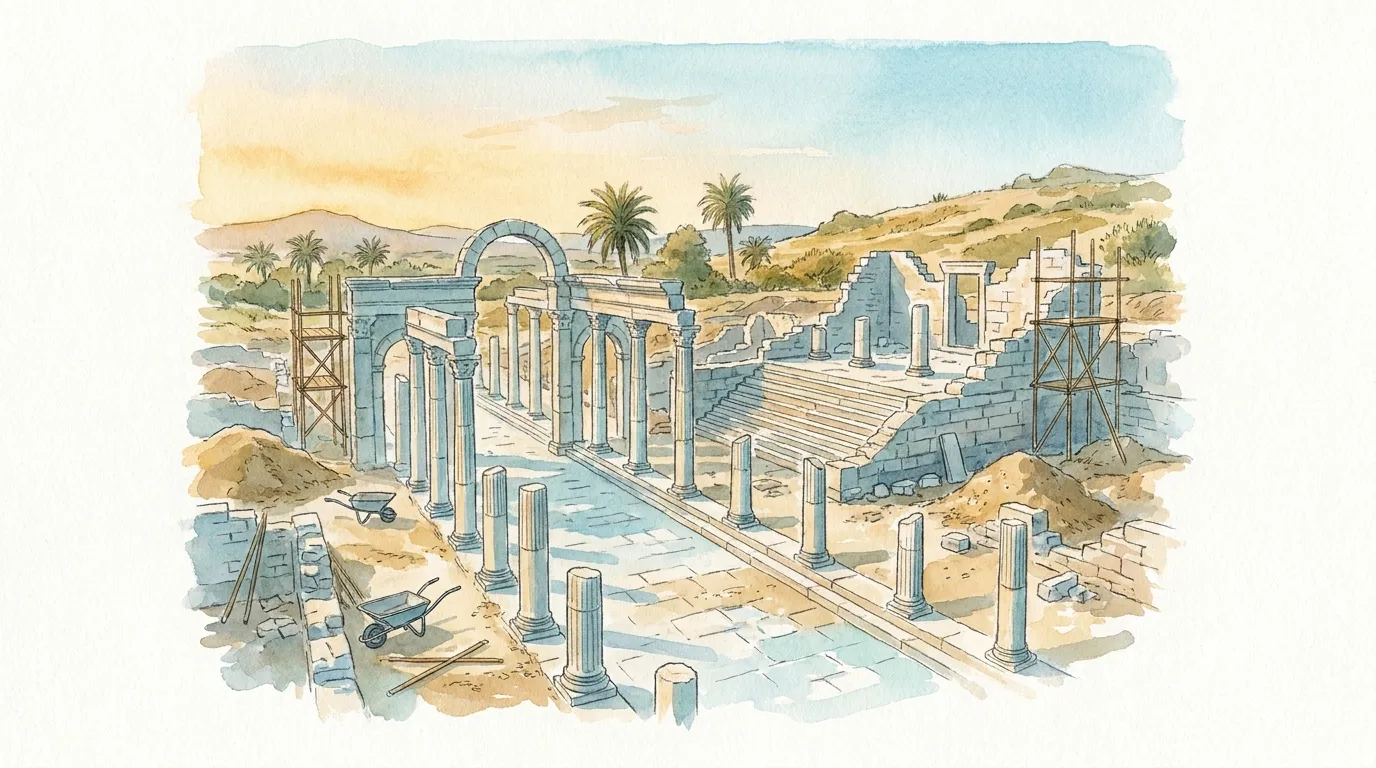
If you’ve read the general guide to Tripolis ancient city and want to know what’s actually on the ground today, the short answer is this: a long colonnaded street with its shop line and drainage still traceable underfoot, the foundations of a council building, and a handful of recent finds that haven’t made it into most guidebooks yet. Tripolis isn’t a finished site. Parts of it are still coming out of the ground while you walk through it, and that’s the reason to go.
The Colonnaded Street, and why it’s the reason to come
The street runs east-west through the center of the ancient city, and it’s the piece of Tripolis that gives you an actual sense of scale. Restoration work has re-set a long run of columns along both sides, and beneath the paving you can still make out the covered drainage channel that carried water and waste out of the commercial district , a detail that tells you more about how a Roman-era market town functioned than any inscription would. Shop fronts line the street at intervals, narrow rooms opening directly onto the pedestrian way, the same layout you’d recognize from Ephesus or Laodikeia but without the crowds.
Walk it in the afternoon if you can. The light comes in low along the column line and the shadows make the street’s length easier to read than they do at midday, when the sun sits flat overhead and the ruins look more like a floor plan than a place people once walked through.
Who’s digging, and what that means for what you’ll see
Excavations at Tripolis are carried out by a team from Pamukkale University, and the site has held year-round excavation status for several seasons now, which is unusual , most ancient sites in the region dig for a few months and close down. That status is what keeps new sections opening up. It also means the site you see in 2026 may have a different footprint than the one photographed a year earlier: a trench that was a bare depression last spring might be a mapped room this autumn.
Because of that, treat any specific claim about “what’s currently excavated” as a snapshot, not a fixed fact. Opening hours, the exact area open to visitors, and any entrance fee should be checked against the official Ministry of Culture and Tourism listing before you go , don’t plan around a number you read somewhere in 2024.
The finds worth slowing down for
A few things are worth looking for specifically rather than walking past. The bouleuterion , the city’s council building, set on a raised podium , gives you the clearest sense of Tripolis as a functioning civic center rather than just a trade stop. Sculptural fragments recovered from the sanctuary areas, some showing stylistic ties to the Antonine period, are displayed near the excavation house rather than removed to a distant museum, which is worth knowing if you’re used to sites where the interesting pieces are two hours away in a city collection.
In the residential quarter, mosaic flooring from Late Antique houses has come up in patches , not the wall-to-wall geometric fields you’d see in a Roman villa site further west, but enough surviving pattern to show that people here were living comfortably long after the city’s commercial peak had passed. None of this is staged for visitors. You’re looking at a dig in progress, with the informational signage a step or two behind the trench itself.
Why Tripolis mattered, and why it still does
Tripolis sat at a crossing point between roads linking Hierapolis and Laodikeia to the wider Lycus Valley trade network, which is the practical reason it grew a market street this size in the first place , goods and people passed through here on their way somewhere else. That in-between position is also why it’s easy to fold into a day that already includes Laodikeia; the two sites sit on the same general route northwest of Pamukkale; and a stop at Tripolis rarely takes more than an hour once you’re there.
Getting there and fitting it into your day
Tripolis sits near Yenicekent, in Buldan district, roughly 40 km from Pamukkale. Most visitors reach it by car or organized tour rather than public transport, and it’s rarely a stand-alone trip , it usually gets paired with Laodikeia or folded into a wider look at the region’s ancient sites, which the things to do around Pamukkale overview covers if you’re still building out your itinerary. If you’re mapping the whole route into Pamukkale from further out, the how to get to Pamukkale guide is the better starting point.
Go expecting a working excavation, not a polished archaeological park. That’s not a shortcoming , it’s the reason Tripolis is still quiet enough to actually look at.
Where these places are
Distances from the travertine entrance. Tap a marker to open its guide.
All places on this map
- The Antique Pool (Cleopatra's Pool)
- The travertine terraces of Pamukkale
- Hierapolis Ancient City (Guide coming soon) · 0.7 km from the terraces
- Karahayıt: the red thermal springs · 5.1 km from the terraces
- Laodikeia: the ruined city across the valley · 9.9 km from the terraces
- Denizli: the working city next to Pamukkale · 15.9 km from the terraces
- Tripolis: a Roman city on the Meander with almost no one in it (Guide coming soon) · 19.8 km from the terraces
- Kaklık Cave: Pamukkale underground · 24.2 km from the terraces
- The Çal vineyard route: high-altitude wine an hour from Pamukkale (Guide coming soon) · 29.6 km from the terraces
Guided tours and day trips in Pamukkale
Skip the planning. Pick a theme below to compare guided tours, balloon rides and day-trip packages, many with instant confirmation and free cancellation.
- Pamukkale + Hierapolis day tour
- Hot air balloon ride
- Sunset tour
- Day trip from İzmir
- Day trip from Antalya
- Cleopatra antique pool
Coming out this way?How to get there →