
Pamukkale.ioHierapolis & beyondExplore
Hierapolis Temple of Apollo: Sanctuary on a Fault Line
The Temple of Apollo sat above a fault line in Hierapolis, where priests read gas fumes as oracles. Here's what remains today, and why it was built on this exact spot.
Updated
Hierapolis Temple of Apollo: Sanctuary on a Fault Line
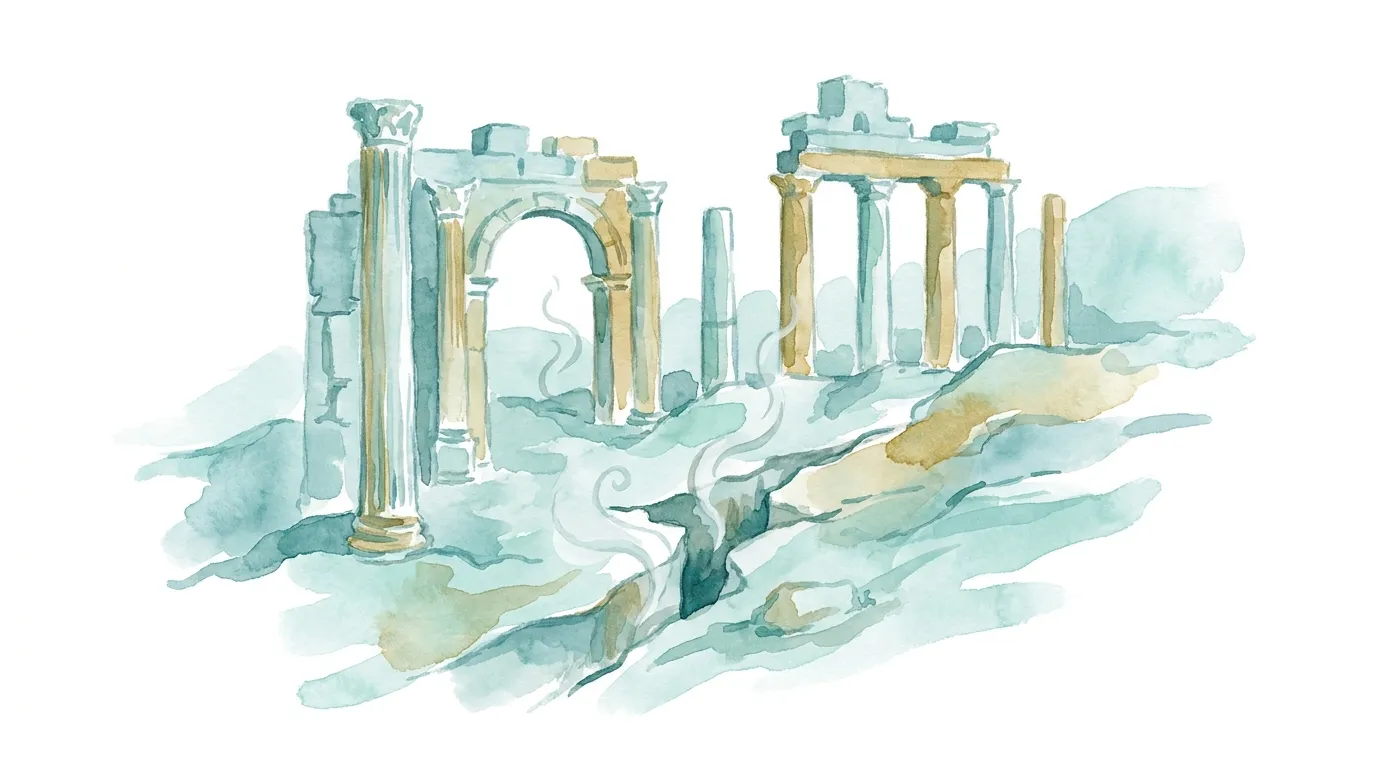
The Temple of Apollo was the religious center of Hierapolis, built for the god the city credited as its founder. What remains today is a stone platform, a row of column bases, and a narrow opening in the rock behind it that still lets out a thin trace of gas. That opening is the reason the temple stands exactly where it does. This wasn’t a random plot of land picked for its view , it sits directly above a geological fault, and the people who built Hierapolis knew it.
Why the priests built here, not somewhere else
Apollo held a specific title at Hierapolis: Archegetes, the Founder. Cities across Anatolia worshipped Apollo, but here the cult merged with an older, local god, Lairbenos, giving the sanctuary a double authority , Greek and Anatolian at once. That mattered, because the temple wasn’t just a place to leave offerings. It sat right beside the Plutonium, a fissure in the ground that released carbon dioxide from deep fault lines beneath the Lycus valley. Priests who could walk near the opening without collapsing , likely by staying just above the heavier, ground-hugging gas , were seen as protected by the god himself. Their survival became proof. Sacrificial animals led closer to the vent were not so fortunate, and ancient visitors like the geographer Strabo wrote about watching this from a safe distance. The temple’s oracle drew its credibility from the fault line, not despite it.
Some pockets of gas near the old Plutonium enclosure can still reach concentrations worth respecting , fenced areas exist for a reason, and any current safety notice on site should be treated as the final word rather than what’s written here.
Hellenistic foundations, a Roman-era rebuild
The temple standing today is not one building but two, layered on top of each other. Excavations trace the earliest sanctuary to the Hellenistic period, roughly the 3rd century BCE, not long after Hierapolis was founded. That original structure was more modest, built from local stone in a style closer to the smaller Anatolian temples of the era. What survives above ground mostly dates from a much larger Roman reconstruction carried out under the Severan emperors in the 3rd century CE, when Hierapolis had grown wealthy from its thermal springs and textile trade. The Romans didn’t just repair the old temple , they rebuilt it at a bigger scale, with a Doric colonnade framing a wide temenos, a monumental staircase leading up from the sacred courtyard, and stronger foundations designed, whether deliberately or not, to withstand the ground movement the site sat on.
Much of what visitors can make sense of today owes itself to the Italian Archaeological Mission (MAIER), whose anastylosis work over recent years has put fallen column drums and architrave blocks back roughly where they once stood, rather than leaving them scattered as rubble. It’s slow, careful work, and it’s part of why the temple reads more clearly now than it did a generation ago , though it’s still a ruin, not a reconstruction you’d mistake for the original.
Finding the temple on site
The Temple of Apollo sits on the terrace between the Hierapolis theatre above and the antique pool below, which makes it an easy stop if you’re already walking that stretch rather than a detour. Coming down from the theatre, you’ll reach the temple platform before the pool, with the fenced-off Plutonium opening just to its side , worth a look, not worth lingering directly over. The site isn’t signed with much detail, so knowing the story beforehand changes what you’re looking at: without it, the temple can read as just another stone platform among many at Hierapolis.
Opening hours and ticket prices for the archaeological site change often enough that it’s worth checking the current figures rather than relying on what’s printed here , the tickets, prices and hours guide keeps that updated for the season.
If the Temple of Apollo is the piece that pulled you in, it’s worth reading it alongside the rest of the ancient city rather than on its own , the Hierapolis ancient city guide lays out how the temple, theatre, and necropolis fit together on one visit, and it’s the natural next stop before you plan your route through the ruins.
Where these places are
Distances from the travertine entrance. Tap a marker to open its guide.
All places on this map
- The Antique Pool (Cleopatra's Pool)
- The travertine terraces of Pamukkale
- Hierapolis Ancient City (Guide coming soon) · 0.7 km from the terraces
- Karahayıt: the red thermal springs · 5.1 km from the terraces
- Laodikeia: the ruined city across the valley · 9.9 km from the terraces
- Denizli: the working city next to Pamukkale · 15.9 km from the terraces
- Tripolis: a Roman city on the Meander with almost no one in it (Guide coming soon) · 19.8 km from the terraces
- Kaklık Cave: Pamukkale underground · 24.2 km from the terraces
- The Çal vineyard route: high-altitude wine an hour from Pamukkale (Guide coming soon) · 29.6 km from the terraces
Guided tours and day trips in Pamukkale
Skip the planning. Pick a theme below to compare guided tours, balloon rides and day-trip packages, many with instant confirmation and free cancellation.
- Pamukkale + Hierapolis day tour
- Hot air balloon ride
- Sunset tour
- Day trip from İzmir
- Day trip from Antalya
- Cleopatra antique pool
Coming out this way?How to get there →