
Seven Churches of Laodicea: The Lukewarm Church of Revelation
Laodicea was the last of the seven churches named in Revelation, criticized for being neither hot nor cold. Here's what the ruins and the water reveal.
Updated
Seven Churches of Laodicea: The Lukewarm Church of Revelation
Laodicea is the seventh and last of the churches addressed in the Book of Revelation, and it’s the one that gets the sharpest words: neither hot nor cold, lukewarm, about to be spit out. If you’re standing in the ruins today, that criticism isn’t abstract. The city’s own water supply, piped in from two directions, arrived lukewarm and full of lime, and the text seems to know it. This piece stays with that connection between the biblical letter and the ground it was written about. For the wider history of the city, the Laodikeia ancient city guide covers the agora, the stadium, and the rest of the site.
What Revelation 3:14-22 Says About Laodicea
The letter to Laodicea, in Revelation 3:14-22, opens differently from the other six. There’s no compliment before the correction. The church is told it is lukewarm, and that this is worse than being cold or hot outright. It’s then quoted as saying “I am rich, I have prospered, and I need nothing” , a line that matches what we know about the city’s actual history. After a major earthquake around AD 60, Laodicea rebuilt itself without accepting financial help from Rome, a fact the Roman historian Tacitus recorded with some surprise. A city proud enough to refuse imperial aid is also a city that might tell its own church it needs nothing from anyone, including its faith. The letter answers that pride directly, telling the congregation it is, in spiritual terms, poor, blind, and naked , the opposite of how it saw itself.
If you’re reading this as part of planning a faith-focused stop, it helps to know the letter isn’t a general warning about mediocrity, as it’s sometimes preached today. It’s addressed to a specific, wealthy, self-sufficient city, and the language borrows directly from that city’s own water and industry , its banking, its wool trade, and the eye salve it was known for producing.
Why Lukewarm? The Water That Explains the Metaphor
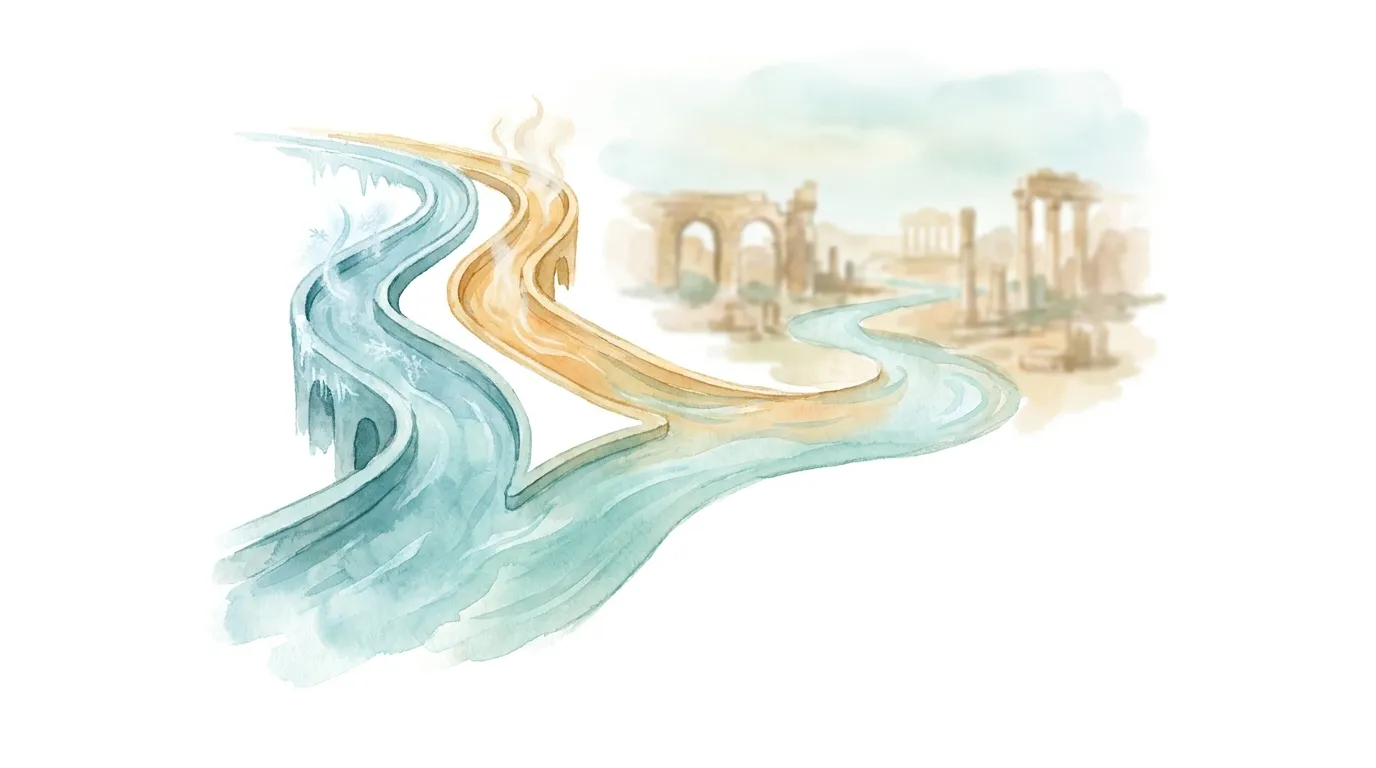
Laodicea sat between two water sources with opposite temperatures. Hierapolis, a few kilometers north, sent hot mineral water down through the valley , the same water that built the white travertine terraces visitors know today at Pamukkale. From the other direction, cold water came down from Colossae, near modern Honaz, fed by mountain snowmelt. By the time either supply reached Laodicea through its aqueduct system, it had lost its original temperature and picked up heavy mineral deposits along the way. What arrived in the city was neither refreshingly cold nor therapeutically hot , it was tepid, chalky, and by most accounts unpleasant to drink.
You can still see the evidence of this in the calcium buildup inside the surviving sections of Laodicea’s water channels and pipes, thick white deposits that narrowed the pipes over time much the way they built up the terraces at Hierapolis on a larger scale. Whoever wrote the letter to this specific church knew the local water well enough to use it as an image people would recognize immediately, not as a generic metaphor. That’s part of why scholars treat the Laodicea letter differently from the others in Revelation , the criticism is built from the city’s own geography, not borrowed language. The Hierapolis ancient city guide covers the hot-water side of that same system in more detail if you want the fuller picture.
The Laodicea Church Ruins Today
The physical evidence of Christian Laodicea sat buried until excavations uncovered a large basilica-plan church in 2010. The building is generally dated to the 4th century, in the period after Christianity became legal under Constantine , though if you’re citing a precise construction year for academic purposes, it’s worth checking the excavation team’s published reports, since dating on a site this size is often refined as work continues. What’s clear on site is the scale: a monumental structure with a nave, side aisles, and an atrium, built at a time when Christian communities in Asia Minor had moved from meeting quietly in homes to constructing large public buildings.
Inside, sections of mosaic flooring and painted plaster have been protected under glass walkways, so you look down through the floor rather than walking directly on the ancient surface. A baptistery survives near the main hall, which tells you this wasn’t just a meeting space but a functioning center for the local Christian community, likely including converts being formally received into the faith. The restoration work on the building has been recognized with a Europa Nostra cultural heritage award, and the site is included on Turkey’s UNESCO World Heritage Tentative List , details worth confirming on the official sources before quoting figures, since recognition status and visitor access can shift from one season to the next.
Planning a Visit Around the Biblical Sites
Laodicea, Hierapolis, and Colossae form a rough triangle that a lot of faith-tourism groups already move through, usually without stopping long enough to explain how the sites relate to each other biblically. If your interest is specifically the Seven Churches of Asia Minor rather than the wider archaeological history, it’s worth telling your guide or tour organizer that in advance , some standard Pamukkale itineraries treat Laodicea as an optional add-on rather than a planned stop, and the church excavation area is a fairly short walk from the main entrance once you’re there.
For groups building an itinerary around this theme, the best Pamukkale tours for 2026 page lists which operators currently include Laodicea as a stop, since not all of them do. If you’d rather arrange transport and a base independently, the Denizli city guide covers how close Laodicea sits to the city center and what a self-planned day looks like.
Where these places are
Distances from the travertine entrance. Tap a marker to open its guide.
All places on this map
- The Antique Pool (Cleopatra's Pool)
- The travertine terraces of Pamukkale
- Hierapolis Ancient City (Guide coming soon) · 0.7 km from the terraces
- Karahayıt: the red thermal springs · 5.1 km from the terraces
- Laodikeia: the ruined city across the valley · 9.9 km from the terraces
- Denizli: the working city next to Pamukkale · 15.9 km from the terraces
- Tripolis: a Roman city on the Meander with almost no one in it (Guide coming soon) · 19.8 km from the terraces
- Kaklık Cave: Pamukkale underground · 24.2 km from the terraces
- The Çal vineyard route: high-altitude wine an hour from Pamukkale (Guide coming soon) · 29.6 km from the terraces
Guided tours and day trips in Pamukkale
Skip the planning. Pick a theme below to compare guided tours, balloon rides and day-trip packages, many with instant confirmation and free cancellation.
- Pamukkale + Hierapolis day tour
- Hot air balloon ride
- Sunset tour
- Day trip from İzmir
- Day trip from Antalya
- Cleopatra antique pool
Coming out this way?How to get there →