
Pamukkale.ioHierapolis & beyondExplore
Saint Philip Martyrium at Hierapolis: Visitor Guide
The Saint Philip Martyrium at Hierapolis is a steep hilltop memorial. Learn the climb time, tomb location, access limits, ticket rule, and when to go.
Updated
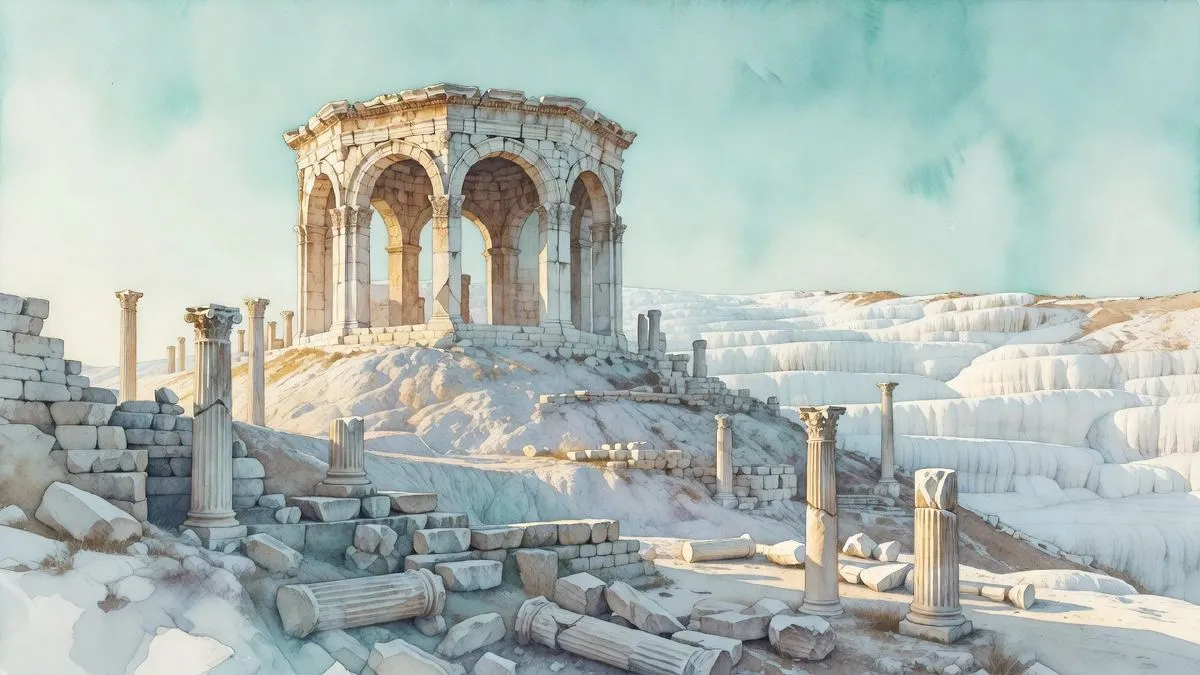
The Martyrium of Saint Philip is a 5th-century octagonal memorial on a hill above Hierapolis. The walk begins behind the theatre and takes roughly 10 to 15 minutes uphill at a steady pace, or closer to 20 to 30 minutes with stops. The return trip and the hilltop usually take 1.5 to 2 hours in total. There is no separate Martyrium fee: entry is included in the main Hierapolis and Pamukkale site ticket, while opening hours follow the main archaeological site. Ticket rules and hours can change, so the official information should be checked before a 2026 visit. The climb is worth considering if your group is comfortable with steep, exposed ground; it is not a practical stop for wheelchairs, strollers, or visitors with significant mobility difficulties.
The monument commemorates Philip the Apostle, one of Jesus’s twelve disciples, who was believed to have been martyred in Hierapolis around AD 80. The Martyrium itself is not his tomb. That distinction matters because the octagonal ruin on the summit and the nearby Tomb Church are two different parts of the same pilgrimage complex.
Why the Martyrium is separate from the tomb
Philip is traditionally associated with the spread of Christianity in Hierapolis and with a martyrdom there, probably by crucifixion or hanging. His death turned the city into an important Christian pilgrimage centre, adding a religious layer to a place better known today for its Roman streets, theatre, and thermal setting. The Martyrium marked the place connected with his death and gave pilgrims a destination at the top of the hill.
The structure was built in the early 5th century, several centuries after Philip’s death. Its octagonal plan is the feature that defines it. In Christian architecture, the number eight was associated with resurrection and renewal. A central domed space was surrounded by smaller rooms, which formed a setting for prayer and for pilgrims staying near the shrine. Much of the dome has disappeared, but the geometry of the building remains clear when viewed from the ridge.
The actual burial site is a short distance away and lower on the slope. In 2011, a team led by Italian archaeologist Francesco D’Andria identified a 1st-century Roman grave beneath the remains of a Byzantine church, now known as the Tomb Church. The grave, inscriptions, and later construction around it supported its identification as Philip’s original resting place. The current archaeological interpretation distinguishes the Tomb Church as the burial site and the octagonal building as the memorial.
This is the simplest way to remember the layout: the eight-sided building on the highest part of the hill is the Martyrium; the lower, rectangular, three-aisled ruin is the Tomb Church. Signage can be limited, so the distinction is easier to follow from the shape and position of the buildings than from labels alone.
The Martyrium belongs within a wider understanding of the ancient city rather than as an isolated chapel. The Hierapolis ancient city guide gives the broader layout, while this hilltop explains why the city continued to attract visitors after its Roman urban life had changed.
How difficult is the walk to the hilltop?
The route leaves the main level of Hierapolis behind the theatre and follows the ancient Processional Way. In Byzantine times, pilgrims climbed this approach to reach the hill associated with Philip. Today, the first part of the route can feel like a normal archaeological path, but the gradient becomes more noticeable as it rises. The surface changes between worn paving, steps, and loose rubble, so the walk requires more attention than the flat colonnaded streets below.
The route is short in distance but demanding in conditions. The slope remains fairly consistent until the final section, and shade is almost absent between the theatre area and the summit. Cisterns and the remains of a small bridge appear beside the route, giving the climb some historical points to pause beside. The view also opens gradually rather than all at once. Looking back halfway up brings the theatre tiers, the Lycus Valley, and the lower plateau into the same frame.
Heat is usually the bigger issue than the length of the climb. There is nowhere reliable to buy or refill water after leaving the main visitor routes, and the exposed limestone gives little relief in summer. A hat, sunscreen, and more water than expected are sensible parts of the visit. Shoes with a secure grip are more useful than smooth sandals on the loose stones and polished sections.
The route has no ramp alternative. Its gradient, steps, and broken surfaces make it unsuitable for wheelchairs and strollers. Families with very young children generally find a child-carrier backpack more workable than a buggy. Visitors with limited mobility may get more from the theatre terraces and the main plateau below than from attempting the ascent. The Hierapolis Theatre is also the natural starting point for understanding where the Processional Way begins.
What can you see at the Martyrium?
At the summit, the octagonal plan is easiest to understand from the outside. The central space is framed by substantial walls and surviving arches, with smaller chambers arranged around it. The ruins do not present a complete church interior, so the building is best read through its footprint, position, and relationship to the nearby Tomb Church rather than through intact decoration.
The hilltop also explains the ritual character of the site. The climb separates the memorial from the busy streets below, and the changing elevation makes the approach feel deliberate even when visitors are there for archaeology rather than worship. Water installations and bridge remains along the Processional Way point to the practical needs of a route used by pilgrims, while the summit provided a visible destination above the city.
There are three useful places to pause. Midway up, the view back toward the theatre shows how sharply the route rises from the main plateau. Beside the octagonal building, the ridge opens toward the plain, the travertines, and the modern town. Inside the surviving arches, open sky replaces the missing roof and gives a clear sense of the original height. The site is often quieter than the theatre and the lower streets because many visitors do not continue up the hill.
Morning generally gives the stone a softer appearance and makes the exposed section more manageable than the middle of the day. In July and August, the heat on the slope can become uncomfortable or unsafe around midday. An early visit is therefore a practical choice for both the walk and the light, rather than a rule that applies to every season. Cloudier days can also make the ascent easier, although the uneven ground still needs care.
The nearby Tomb Church completes the story. Its lower position and rectangular plan make it visually different from the Martyrium, but both sites should be read together. Seeing only the octagon can leave the mistaken impression that Philip’s grave was inside the memorial. Seeing the two ruins as separate parts of one pilgrimage landscape makes the 2011 discovery easier to understand.
Is the Martyrium worth adding to a Hierapolis route?
For visitors interested only in the most accessible Roman remains, the Martyrium may not justify the extra climb. The theatre, Frontinus Street, the necropolis, and the main plateau provide substantial ruins without the same exposure or uneven ascent. The hilltop becomes a better choice when the group has time, suitable footwear, enough water, and an interest in early Christian history rather than only the famous thermal landscape.
The practical cost is not a second entrance ticket but time and energy. The Martyrium is included in the main site admission, yet the climb can affect the rest of the day, especially after walking across the travertines. The route also offers little shelter, so a tired group may find the return harder than the ascent. Visitors who are already planning the theatre and upper Hierapolis have a more natural opportunity to include it.
The monument’s importance comes from the contrast between its appearance and its purpose. It looks like a large hilltop church, but it was built as a memorial at the place linked with Philip’s death. A few metres away, beneath a later Byzantine church, the grave was identified as a separate place. That relationship between memory, burial, and pilgrimage is what makes the site more than another ruin on the Hierapolis plateau.
The practical next step is to place the Martyrium after the theatre in a morning Hierapolis route, allowing extra time for the exposed climb and checking the official 2026 ticket and opening information before departure.
Where these places are
Distances from the travertine entrance. Tap a marker to open its guide.
All places on this map
- The Antique Pool (Cleopatra's Pool)
- The travertine terraces of Pamukkale
- Hierapolis Ancient City (Guide coming soon) · 0.7 km from the terraces
- Karahayıt: the red thermal springs · 5.1 km from the terraces
- Laodikeia: the ruined city across the valley · 9.9 km from the terraces
- Denizli: the working city next to Pamukkale · 15.9 km from the terraces
- Tripolis: a Roman city on the Meander with almost no one in it (Guide coming soon) · 19.8 km from the terraces
- Kaklık Cave: Pamukkale underground · 24.2 km from the terraces
- The Çal vineyard route: high-altitude wine an hour from Pamukkale (Guide coming soon) · 29.6 km from the terraces
Guided tours and day trips in Pamukkale
Skip the planning. Pick a theme below to compare guided tours, balloon rides and day-trip packages, many with instant confirmation and free cancellation.
- Pamukkale + Hierapolis day tour
- Hot air balloon ride
- Sunset tour
- Day trip from İzmir
- Day trip from Antalya
- Cleopatra antique pool
Coming out this way?How to get there →