
Pamukkale Sunset: Why Overnight Beats a Day Trip
Day tours leave before golden hour starts. Staying overnight in Pamukkale village or Karahayit is the only way to see the travertines at sunset.
Updated
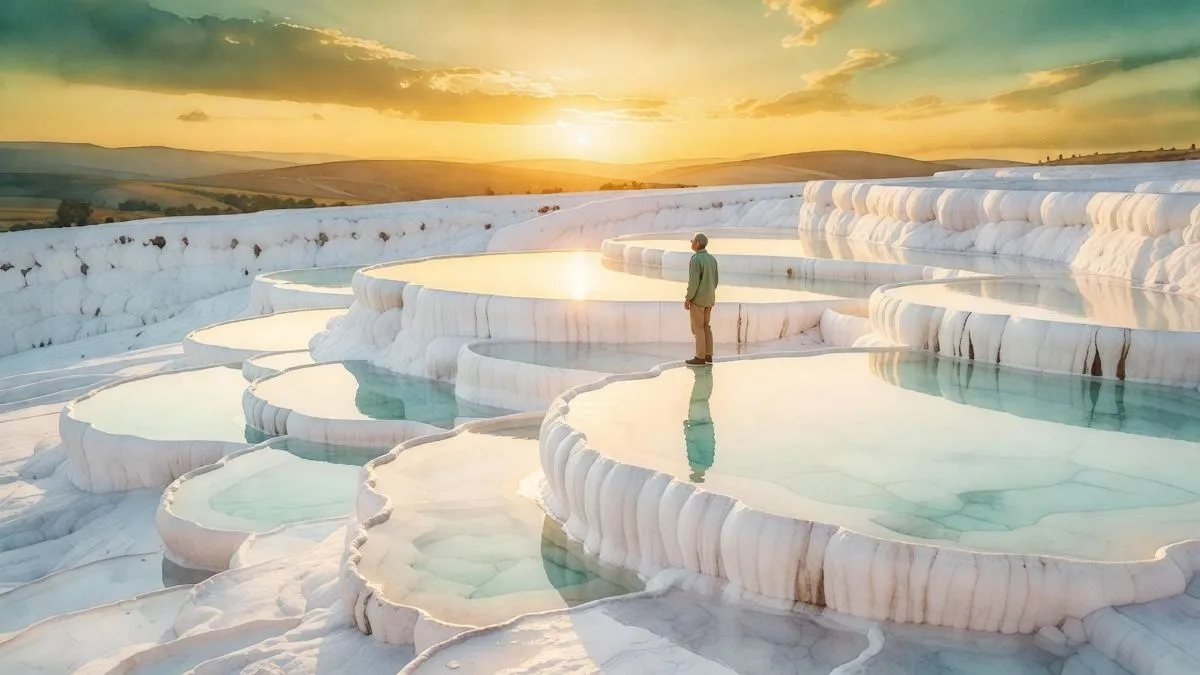
Why day-trippers miss the Pamukkale sunset
Day tours from Izmir, Antalya, and Istanbul run on a round-trip schedule built around bus or flight departures. That schedule forces a departure from Pamukkale in the late afternoon, well before the sun drops behind the travertines.
The departure time is fixed before the light becomes a factor. A typical day-tour itinerary arrives mid-morning, visits the travertines and Hierapolis, then boards the bus for the return leg while the golden hour is just starting. By the time the light turns amber and the crowds thin out, the bus is already on the highway back to Izmir or Antalya.
The operator needs to meet the drop-off time at your hotel or the airport. The return schedule was set long before you boarded, and it does not flex for sunset.
Golden hour on the travertines is a slow shift in the white itself, from chalk-bright to warm cream, and the shallow water over the terraces picks the color up before the sun is gone. Tour operators understand this as well as anyone. They still leave on time, because the bus has a schedule to keep.
Staying overnight flips the equation. You walk the travertines when the day-tripper buses are gone. You watch the light change over the ancient pool and the theatre without anyone rushing you. Then you wake up in Pamukkale instead of spending another four hours on a bus.
The catch: overnight means choosing where to sleep. Pamukkale village is a short walk from the gates. Karahayit, six kilometers up the road, adds thermal hotels and a quieter evening but distances you from the travertines. Both options get you the sunset. Neither gets you the sunset if you booked a day tour and did not plan the return.
A day trip from Izmir, Antalya, or Istanbul means the bus leaves before the sun does. The only way to see Pamukkale at sunset is to sleep in Pamukkale or Karahayit that night.
Tickets, re-entry and seasonal timing
Same-day re-entry is the practical answer to “can I visit the site in the afternoon and catch the sunset.” Pamukkale-Hierapolis entry tickets are valid for the same calendar day, meaning you can exit the terraces in the late afternoon and re-enter without buying a second ticket. The catch is that you must still be inside the site before the closing gate, which is set by the seasonal sunset window rather than a fixed clock.
Operating hours shift with the sun. In summer (roughly June through August), the site stays open until around 19:30, occasionally 20:00, giving a tight but workable buffer after the last terrace walk. In winter (December through February), closing drops to approximately 17:00 or 17:30, which means the sun is already low or set by the time most visitors reach the upper terraces. The ticket office closes 30 minutes before the site gate, so arriving at 18:30 in summer or 16:30 in winter leaves no margin.
Current hours and ticket pricing are listed on the current tickets and opening hours page; they change by season and by date, and printed tables go stale fast. That page is the single reliable source for the exact closing time on your travel date.
If sunset is the goal, plan the timing backward from the closing gate. Aim to be inside roughly two hours before sundown: the first hour covers the terraces and the theatre in full daylight, the second covers the moment the white changes. The ticket office closes before the site gate, so the entry time is the number to hold in your head.
For day-trippers arriving from Izmir, Antalya, or Istanbul, the calculation is straightforward: if your return bus or transfer departs before the summer closing gate, you can still reach the upper terraces and watch the light fade over the travertines. If your transfer leaves at 17:00 in mid-August, you will be walking down the hillside in shadow, missing the golden hour entirely. Winter day-trippers face a narrower window and should treat the site as a morning-to-early-afternoon stop, not an evening one.
Where to stay: Pamukkale village or Karahayit?
Pamukkale’s village and Karahayit offer genuinely different rhythms, not just different distances. The full, hotel-by-hotel comparison lives on the where to stay in Pamukkale guide; the sunset question narrows the choice to two moves.
Pamukkale village
Pamukkale village sits within 500-800 meters of the archaeological site, a 10-minute walk. This proximity matters directly if sunset is your goal. The site closes seasonally, and golden light often lingers until minutes before the gates lock in spring and autumn. Being steps away means you can time your entry to peak conditions without waiting for transport or negotiating rides when evening drivers are occupied elsewhere. The village has small hotels and guesthouses clustered near the center. Most rooms are simple, sometimes without views, but location is uncompromised. Practical bonus: upper streets in the village offer sight lines to the pool terraces even outside the ticket gates, so you can gauge the light and timing before you enter. Spontaneity is possible because you are always walking distance away.
Dinner follows the terrace walk without any planning: the village’s restaurants sit along the same short stretch, and several are built high enough on the slope that the last color stays visible from the table. You can check the light from the hotel step, decide to go up or stay put, and still have time either way.
Karahayit
Karahayit, 5-6 kilometers south, trades proximity for thermal access. The transfer takes 10-15 minutes by taxi or hotel shuttle, which means you must arrange transport in advance, no casual dash at dusk. But once back after sunset, Karahayit’s identity shifts entirely. The town centers on thermal hot-spring hotels and spa facilities. Your evening unfolds in warm mineral water instead of cooling village streets. Most thermal hotels have outdoor or semi-outdoor pools where you can soak under stars. The travertine landscape is not part of Karahayit’s setting; your nighttime experience revolves around the spa and thermal comfort instead. It is a completely different version of “evening in Pamukkale.”
Evening here runs on a different clock: the terrace at dusk, a short ride back down the hill, then a soak in water that stays warm long after the air cools. The hotels were built around the thermal pools, which is why the night continues instead of ending at the hotel door.
The choice depends on what you want your night to be. Choose Pamukkale village if ease and spontaneity matter, you can step out multiple times, check the light, walk to the site on impulse. Choose Karahayit if you want sunset at the terraces but prefer your evening to end in thermal water. Both options assume you are staying specifically to witness the sunset; once that decision is made, these two paths offer distinct ways to spend the hours after dark.
Two small things to confirm before you book
Two details determine whether the plan works. First, the site’s closing time on your actual date, since it shifts across the year and the sunset has to fall inside it. Second, if you want to extend the experience into a full day, Pamukkale’s hot-air balloon flights lift off at first light, when the terraces are nearly empty and the sun has not yet turned the white into glare. Being at the launch point in the dark is far easier from a hotel in the village than from Denizli.
The practical order is the room first, the flight second, and the forecast makes the final call. A reservation made before the tour date decides whether you watch the golden hour from the terraces or from the highway.