
Pamukkale.ioHierapolis & beyondExplore
Ancient Thermal Culture in Pamukkale: Phrygian and Roman Roots
Learn how Phrygian beliefs, Roman bathing, sacred springs, trade and water management shaped Pamukkale’s ancient thermal culture around Hierapolis.
Updated
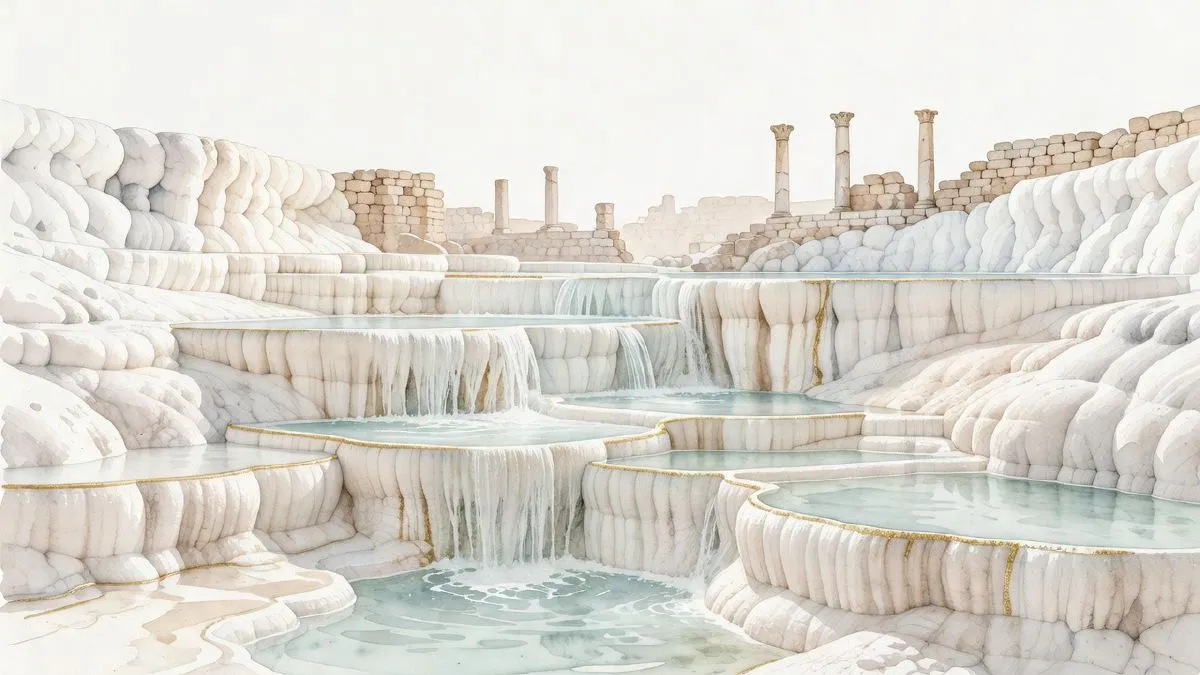
Pamukkale’s ancient thermal culture was not simply about bathing. From the Phrygian period into the Roman era, hot springs served religious, healing, social and economic purposes. Hierapolis became the main centre of this activity, while nearby Laodikeia connected mineral-rich water with bathing and textile production. The evidence is strongest for the Hellenistic and Roman periods; earlier Phrygian use is suggested by the region’s settlement history and religious traditions, but direct proof of specific Phrygian bath buildings remains limited.
How did Phrygian beliefs shape the thermal landscape?
The Phrygians occupied central and western Anatolia between roughly the 12th and 6th centuries BCE. Their religious world was closely associated with mountains, caves, springs and the Mother Goddess Cybele. These places were understood as points of contact between the human world and divine forces. In that setting, a hot spring could be treated as more than a useful water source. Heat, steam, unusual mineral deposits and the visible movement of water all gave it a ritual meaning.
The connection between Phrygian religion and the springs around Pamukkale should be described carefully. Archaeological evidence for a specific Phrygian thermal sanctuary at Karahayıt or on the Pamukkale terraces is limited, and no secure inscription identifies an early Phrygian bathhouse there. It is safer to speak of a regional tradition in which springs and caves could support purification, healing or offerings. Later religious practices may have absorbed some of these older associations rather than replacing them completely.
Early use was probably modest in architectural terms. People could approach a spring for washing, treatment or a ceremony without needing the large masonry complexes that appeared later. The important idea was the water itself. It was a natural agent with a perceived power to cleanse, restore or mediate with the divine.
When the Attalid rulers established Hierapolis in the 2nd century BCE, they placed a planned city within a landscape that already carried religious significance. The Hellenistic foundation did not create the sacred character of the springs from nothing. It gave that character an urban setting, with roads, public buildings and organised access to the water.
What changed when Hierapolis became a Hellenistic and Roman city?
Urban development turned thermal use into a more structured system. At Hierapolis, bathing, worship and public life developed around the same resource. The city’s sanctuaries and water installations should not be read as evidence of a modern spa in the tourism sense. People came for religious reasons, medical hopes, ordinary washing, social contact and the practical advantages of a settled water supply.
The Roman period added a more standardised bathing architecture. Large bath complexes were organised around different temperatures and activities. A caldarium provided a hot environment, a tepidarium offered a transitional warm room, and a frigidarium supplied cooler water. In practice, the exact arrangement depended on the building and the available water. At Hierapolis, natural heat reduced the need to produce all warmth through fuel, although heating systems and controlled water movement were still important parts of the architecture.
The Great Bath is generally dated to the Roman Imperial period, with major construction associated with the 2nd century CE. Its surviving walls and rooms show how a thermal facility could be integrated into a city rather than placed apart from it. The building was not only a place for treatment. Bathers met acquaintances, exchanged news and conducted parts of their social life there. Access and comfort still reflected status: wealthier residents could use more private spaces, while public areas brought different groups into the same complex.
The relationship between healing and religion was also visible at Hierapolis. The city’s Plutonium was associated with Pluto and Kore, and its dangerous gases contributed to the site’s underworld symbolism. The sanctuary connected the thermal landscape with death, divine power and controlled ritual performance. The proposed presence of an Asklepion, a healing centre dedicated to Asklepios, should be treated cautiously because the identification and function of some remains remain debated. The broader healing culture, however, is clear from the city’s religious setting, medical expectations and use of the springs.
For the location of these remains and the practical sequence of a visit, see the Hierapolis ancient city guide. That guide covers the wider archaeological site; this article focuses on how water shaped its culture and economy.
How did Roman engineers control the water?
Roman thermal culture depended on infrastructure as much as belief. Water had to be collected, moved, divided and released without damaging buildings or making the bathing areas unusable. Channels, pipes and settling arrangements allowed the city to direct water toward public facilities and other parts of the urban area. Some installations used stone, while others relied on ceramic pipes and channels cut into or built over the ground.
This management was not a single system that remained unchanged for centuries. Channels were repaired, redirected and adapted as mineral deposits accumulated and buildings changed. The water carried dissolved minerals that could leave deposits on surfaces. Controlling the flow helped keep passages open and reduced the risk of water spreading unpredictably through the settlement.
The same principle applied to the terraces. Water movement had to be guided so that deposits did not cover roads, walls or bathing structures too quickly. It would be misleading to describe this as a complete Roman solution to terrace formation, but Roman builders clearly had to work with the flow and its deposits. Their achievement was practical: they made a difficult natural resource usable within a populated city.
The Ancient Pool, now commonly marketed as Cleopatra’s Pool, belongs to this wider history but should not be assigned a simple origin story. Its Roman-period setting and submerged architectural fragments point to long use of a monumental bathing area, while the exact date and sequence of construction and rebuilding remain subjects for archaeological interpretation. The pool was also affected by earthquakes and later repairs. For its present-day visiting conditions and access details, check the Antique Pool guide, since opening arrangements and fees can change. Any current water-temperature figure should also be confirmed with the official site before visiting; modern measurements do not automatically represent ancient conditions.
How did thermal water support trade and daily life?
Thermal water had value beyond the bathhouse. Laodikeia, a major urban and commercial centre in the same region, developed a textile economy that depended on skilled wool production and dyeing. Mineral-rich water may have supported parts of fibre processing, washing or dye fixation, but the exact role of each spring and installation should not be overstated. It was one element within a broader network of labour, raw materials, workshops and trade routes.
The city’s bath complexes also show how water became part of civic identity. Public bathing required maintenance, staff, fuel or water management, and a social framework that made the facilities useful. Mosaics, marble elements and sculpture in some complexes expressed investment and status, while ordinary bathers used the buildings for routine hygiene and social contact. The Laodikeia ancient city guide provides the wider context for the city’s streets, public buildings and commercial role.
At smaller settlements such as Tripolis ad Meandrum, thermal use was likely less monumental. Warm water could still form part of everyday life without producing a large specialised complex. This difference matters when interpreting the region. Ancient thermal culture was not one uniform institution. It ranged from sacred springs and household use to urban baths, medical practice and industrial work.
What should visitors remember about Pamukkale’s ancient thermal culture?
The clearest pattern is continuity with change. The Phrygian period provides a cautious background of spring-centred religious traditions. Hellenistic rulers established Hierapolis as a city. Roman builders then expanded the infrastructure, formalised bathing spaces and connected water management with civic life. Religious meanings remained present beside practical uses, while Laodikeia shows how the same regional water environment could support production and commerce.
The remains are easier to understand when they are not reduced to a list of baths and monuments. A channel represents decisions about flow and maintenance. A bath complex represents both Roman architectural planning and the daily routines of its users. A sanctuary near a dangerous gas emission shows how natural features could be interpreted through myth and ritual. The evidence is uneven, so claims about exact temperatures, visitor numbers, ticket systems or a single organised thermal economy should be checked against current excavation reports and museum information rather than assumed.
For a visit, the most useful question is not whether the ancient city was a spa in the modern sense. It is how one resource could serve several purposes at once: purification, hoped-for healing, social exchange, urban engineering and trade. Read the remains through that combination, then continue with the Hierapolis guide to connect the thermal history with the wider archaeological site.
Where these places are
Distances from the travertine entrance. Tap a marker to open its guide.
All places on this map
- The Antique Pool (Cleopatra's Pool)
- The travertine terraces of Pamukkale
- Hierapolis Ancient City (Guide coming soon) · 0.7 km from the terraces
- Karahayıt: the red thermal springs · 5.1 km from the terraces
- Laodikeia: the ruined city across the valley · 9.9 km from the terraces
- Denizli: the working city next to Pamukkale · 15.9 km from the terraces
- Tripolis: a Roman city on the Meander with almost no one in it (Guide coming soon) · 19.8 km from the terraces
- Kaklık Cave: Pamukkale underground · 24.2 km from the terraces
- The Çal vineyard route: high-altitude wine an hour from Pamukkale (Guide coming soon) · 29.6 km from the terraces
Guided tours and day trips in Pamukkale
Skip the planning. Pick a theme below to compare guided tours, balloon rides and day-trip packages, many with instant confirmation and free cancellation.
- Pamukkale + Hierapolis day tour
- Hot air balloon ride
- Sunset tour
- Day trip from İzmir
- Day trip from Antalya
- Cleopatra antique pool
Coming out this way?How to get there →