
Pamukkale Travel Insurance: What Coverage You Actually Need
Slippery travertines, shadeless ruins, and paragliding rides carry different risks. Here's what your Turkey travel insurance should cover before you go.
Updated
Pamukkale Travel Insurance: What Coverage You Actually Need
A standard travel insurance policy covers a lost bag and a delayed flight. It does not automatically cover a fall on wet limestone, heatstroke in a shadeless ancient city, or a paragliding flight off a hill above the terraces. If you’re heading to Pamukkale, the question isn’t whether to buy insurance , almost every visitor should , it’s whether the policy you’re about to buy actually matches what you’ll be doing there. A basic backpacker plan bought in a hurry often excludes exactly the two things people do here: walk barefoot on a slick natural surface, and jump off a hill attached to a wing.
For most nationalities Turkey doesn’t legally require proof of travel health insurance at the border, but that’s not really the point. The point is what happens if you twist an ankle on the travertines on a Tuesday afternoon: without coverage, you pay the private clinic in Denizli out of pocket, in cash or by card, before anyone treats you. A week-long policy with real medical coverage and evacuation usually runs somewhere in the 15,20,40 USD range depending on age and country of purchase , cheap compared to what an uninsured ER visit and a possible transfer to Izmir would cost. Prices and provider terms shift often, so treat any number here as a starting point and confirm the current rate on the insurer’s site before buying, not after.
What Pamukkale actually puts at risk
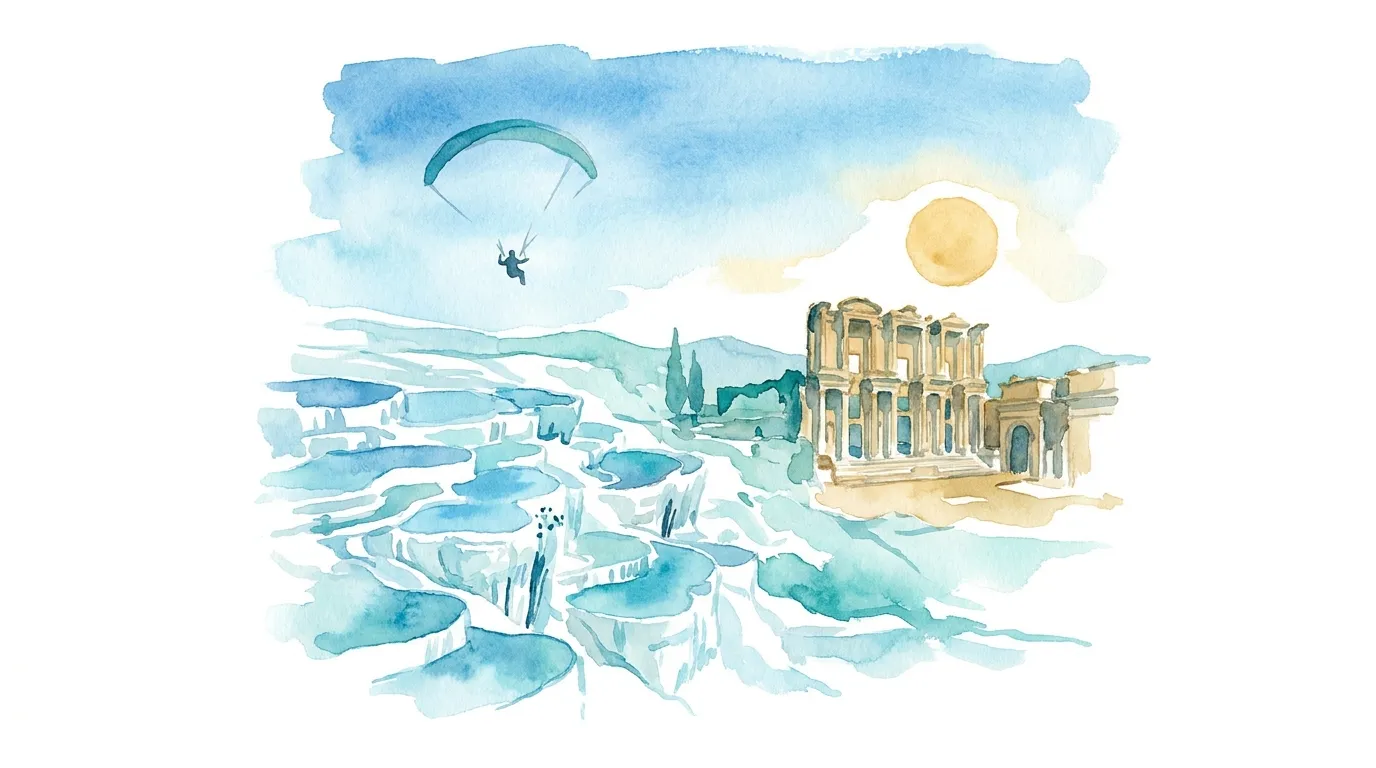
The travertines are the reason most people come, and they’re also the main physical risk. Shoes are not allowed on the white terraces , it’s a rule to protect the mineral surface, not a suggestion , which means every visitor crosses wet, uneven, mineral-coated ground in bare feet or thin socks. Most people manage this without incident, but a slip on a steep pool edge is a genuinely common way to sprain an ankle or cut a foot here, especially later in the day when the surface has been walked on by thousands of people. If you’re planning to spend real time in the pools rather than just the photo spots, it’s worth reading how the terraces are laid out before you go , our travertines guide covers where the footing gets trickiest.
Hierapolis, the ancient city above the terraces, is the second risk and it’s a quieter one: heat, not injury. There is very little shade across the site, the walk from the theatre to the necropolis is long, and in July and August the stone paths radiate heat back up at you. Dehydration and mild heatstroke show up here more than any acute injury, particularly among older travelers who underestimate how far the walking actually is. A policy that covers general medical treatment handles this fine , it’s less about special coverage and more about carrying water and pacing the visit, ideally in the morning before the heat sets in.
Paragliding is where policies actually fail people. Flights off Dinamit Tepe, the hill above Pamukkale, are a genuinely popular add-on for visitors staying a night or two, and it’s easy to book one on the spot without checking your insurance first. Standard travel policies routinely list paragliding under an “extreme sports exclusion,” meaning a shoulder injury from a rough landing simply isn’t covered unless you added a specific rider before the trip. If there’s any chance you’ll take that flight, check for this clause , by name, not just by skimming the summary page , before you land in Turkey, not after you’ve already paid the pilot.
Where you’d actually end up if something happens
Pamukkale itself is a small town built around the site; it doesn’t have a full hospital. The nearest serious medical infrastructure is in Denizli, about 20 minutes away, where Pamukkale University Hospital and several private hospitals handle everything from stitches to fractures to more complicated cases. If you need anything beyond a pharmacy consultation, this is where a taxi or your hotel will send you, and it’s worth having looked at the Denizli city guide once just to know roughly where things sit relative to your hotel.
A basic private-hospital visit for something like an X-ray and a wrapped sprain tends to land in the low hundreds of dollars if you’re paying without insurance , the exact figure depends on the clinic and what’s actually needed, so treat any number as a rough range rather than a quote. Pharmacies (eczane) in Denizli and Pamukkale rotate an on-duty schedule for nights and holidays, similar to most of Turkey; the current nöbetçi pharmacy is usually posted on the door of any closed one nearby, so it’s rarely hard to find, just occasionally inconvenient at 2am.
The clause that actually matters most for a Pamukkale trip is medical evacuation, not the everyday medical limit. If an injury needs a specialist that Denizli doesn’t have on hand, the next step is a transfer to Izmir or Istanbul, and that’s a cost category entirely different from a clinic visit. Confirm your policy’s evacuation limit is a real, usable figure , not a token line item , rather than assuming any policy with the word “evacuation” in it covers this properly.
What to check before you buy the policy
A few specific lines are worth reading closely rather than trusting the summary page. The extreme sports or adventure activities section should name paragliding explicitly if you’re planning to fly , some policies bundle it with skydiving and scuba under one paid add-on, others exclude it outright regardless of what you pay. The medical evacuation limit should be a number you’d actually recognize as sufficient, not a vague “included.” And if you’re traveling on a package tour, particularly common for visitors coming from Japan, Korea, or Taiwan, it’s worth confirming directly with the operator whether insurance is already bundled into the package , some are, some assume you’ve arranged your own, and finding out at the clinic desk is the wrong moment to learn which.
2026 note: coverage terms, evacuation limits, and pandemic-era exclusions on individual policies change fairly often between providers and even between policy years from the same insurer. Whatever specific plan or price you’re comparing, check it against the insurer’s current policy document rather than a review site’s summary from a previous season , the trip is the same, but the fine print rarely stays static that long.
Is it worth buying for a short visit?
If your day in Pamukkale is a few hours on the terraces as part of a longer Turkey trip, general travel medical coverage you’d already want for the rest of the country covers you here too , nothing about Pamukkale specifically demands a separate policy. What changes the answer is the antique pool and the paraglide: soaking in the antique pool means wet stone steps and submerged footing most travel insurers treat as ordinary risk, but the paraglide genuinely doesn’t fall under a standard plan. Anyone doing both should treat the extreme sports rider as the one line item worth double-checking, not an afterthought. It’s also worth a quick look at the 2026 season update before your trip, since site access rules and safety protocols around the pools do get revised between seasons.
Compare two or three policies that name paragliding explicitly and list a real evacuation figure, buy the one that fits, and do it before you’re standing at the base of Dinamit Tepe deciding whether to fly. If you want a quick option: Ekta sells policies entirely online , anyone between 3 and 85 can buy one, the policy reaches your inbox within two or three minutes, and technical support runs 24/7 in several languages. Still check the two points above against your own plan: whether paragliding is named in the policy, and whether the evacuation limit is realistic. (Affiliate link: your price stays the same, it helps keep this guide current.)